Nuremberg, Germany — Inbolt today announced that its 3D AI vision guidance software is now natively integrated into the Universal Robots (UR) Gen 7 robot platform. The announcement was made at SPS 2026 in Nuremberg.
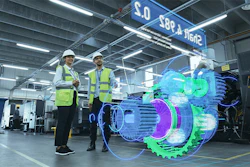
Inbolt Standard lets a UR robot locate a part and adapt its taught path to the part’s actual position on every cycle, for tasks ranging from screwdriving and machine tending to rack loading and depalletizing. A 3D camera on the robot’s wrist recognizes the part from its CAD file, locates it and adjusts the robot’s taught path to the part’s actual position on every cycle. This means manufacturers no longer need to build custom jigs and fixtures for every part and station, making the switch to a new product a software change rather than a tooling project.
UR, a Teradyne Robotics company, said its 7th-generation robot family is now AI-ready out of the box. Following a September launch, Inbolt is one of the first UR+ partners to run an AI application directly on the platform’s CB7 Core controller.
According to UR, Inbolt Standard removes the external industrial PC system that vision guidance has required until now, simplifying installation, deployment and support. With Gen 7’s new tool flange Ethernet connectivity and power connectors, the Inbolt camera connects directly to the robot at the tool flange, so cables are no longer routed along the outside of the arm.
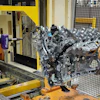
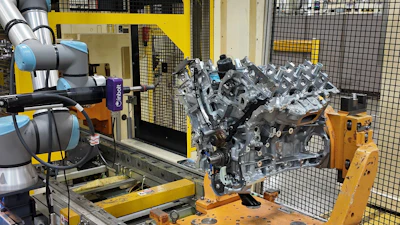
Universal Robots and Inbolt have worked together since 2022, and vision-guided UR robot cells from the two companies already run in production at manufacturers in Europe and North America. For example, Stellantis uses Inbolt guidance at an engine-tightening station to reduce tightening failures by 91%, while requiring just 0.5 seconds of vision processing per engine.
Inbolt Standard covers stationary applications where parts arrive in a repeatable orientation, from single parts to layered racks and trays. In automotive, typical applications include screwdriving and bolt run-down, de-racking, machine tending and layered depalletizing.
The license also opens more of the high-mix electronics and data center hardware segment to collaborative industrial robots, where trays, enclosures and server chassis rarely sit in the same position twice, from tray and rack loading through to fastening and torquing on assemblies. A single program can switch between more than 80 part references, and end-user teams can retrain when a new part arrives.
Inbolt Studio, the software used to train parts and set up stations, runs as a URCap on PolyScope X, and part localization runs on the CB7 Core controller’s own processor. An Orbbec 3D camera connects to the power connector and the 1 Gb Ethernet port in the g-Series tool flange, so its signal runs through the robot.
Training happens locally on the controller from the part’s CAD file in less than 10 minutes, with no image datasets or labeling, and no production data leaving the plant, according to the company. Inbolt commands appear in the PolyScope X program tree and are called like any other URScript instruction.
Repeatability is 0.5 to 0.7 mm on fixed parts and the camera’s active infrared depth sensing works in bright, dim or dark conditions.
Inbolt Standard runs natively on UR’s g-Series robots – UR10g-1750, UR17g-1300 and UR18g-950 – with PolyScope X 10.13 or later. It is also compatible with e-Series and UR Series robots with a CB7 controller. For these, the camera will connect via an external cable.
For more information, visit https://www.universal-robots.com/.