Owners of advanced manufacturing plants and other mission-critical projects are pursuing delivery schedules that leave little room for disconnected decisions. At the same time, skilled labor remains constrained, equipment demand is high, utility capacity is uncertain and regulatory scrutiny is intensifying. On large, multiphase programs, every delay can ripple across dozens of contractors, vendors and technical systems.
Commissioning has traditionally served as the final assurance that the owner’s expectations, the design team’s intent and the contractor’s work align and that completed systems perform as intended. Yet commissioning teams are often retained well into construction, sometimes shortly before equipment installation or functional testing. By that point, many consequential decisions have been made, systems are taking physical form and the available response to a problem may be costly rework.
That conventional model can leave useful expertise underused when stakeholders need it most. A broader approach brings the commissioning authority into concept development, design, procurement, scheduling, installation readiness and phased turnover. The role still includes verification and testing, but it also provides the project with an informed connective layer among specialized activities that might otherwise remain isolated.
The opportunity begins with moving commissioning farther upstream.
Earlier Insight, Greater Influence
During concept development and design, commissioning stakeholders can evaluate how proposed systems will eventually be operated, controlled, tested and maintained. They can identify difficult control sequences, gaps in utility planning, access concerns and performance requirements before those issues reach the field. A revision that requires changing lines on a drawing is far less disruptive than one that requires reconfiguring installed piping or replacing equipment.
Early participation also gives the commissioning team time to understand the owner’s business priorities and build credibility with designers, contractors and trades. That familiarity matters because expanded commissioning depends on cooperation. Team members are more likely to share information and act on recommendations when they understand that commissioning is helping them complete their work, rather than adding another layer of inspection.
As design gives way to construction, the same systems-level perspective can bring needed discipline to the schedule.
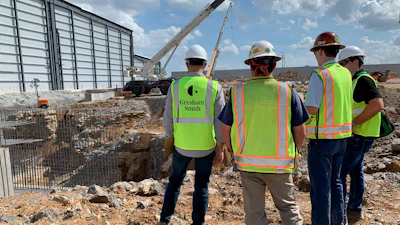
 Gresham Smith
Connecting the Schedule to the Field
On complex projects, each subcontractor may know its own responsibilities without seeing the full sequence required to make a system operational. The commissioning authority understands those dependencies and can help incorporate them into the construction schedule. That work can include defining commissioning activities, identifying prerequisites, coordinating trade participation and estimating the workforce needed for startup and testing.
This involvement is especially valuable because commissioning sits near the end of a long chain. Functional testing cannot begin until equipment has arrived, been inspected and installed, received power and utilities, completed startup protocols and been connected to controls. If one trade is understaffed or performs work out of sequence, the effect may remain hidden until late in the project, when the schedule is less forgiving and there is little margin to absorb changes.
Making equipment information visible to everyone who needs it can reveal those gaps earlier. Commissioning software can record procurement status, delivery dates, on-site locations, inspections, installation readiness and completion. When a transformer arrives, for example, the documentation can notify the electrical contractor that the next activity can begin. If delivery slips, the team can engage the vendor before the missed milestone becomes a larger problem.
This coordinated view also prepares the team to answer a more consequential schedule question.
Defining What Done Means
When an owner asks a project team to finish a multimillion-square-foot manufacturing facility sooner, the instinct may be to compress the schedule or add more people. Yet commissioning cannot create meaningful time simply by accelerating tests. Adding commissioning staff also requires corresponding support from contractors and multiple trades, who may already be working overtime or on multiple shifts. The easiest way to shorten that phase would be to omit work, an approach that would introduce unacceptable performance and operational risks.
A better response begins by asking what the owner needs to accomplish by the target date. On one large manufacturing program, the immediate business objective was not occupancy of the entire facility. The owner needed one production line operating so that a first product run could be tested in time to support a planned market launch.
That distinction transformed the assignment. Instead of treating several million square feet as the immediate critical path, the team traced every dependency serving one production zone. The list included power, water, ventilation, controls, piping, compressed air and the specific air-handling and electrical equipment required for operation. Each dependency could then be mapped against procurement, installation, startup and commissioning dates.
Where an item fell outside the required sequence, the team could consider earlier delivery, temporary equipment, a design adjustment, or another focused contingency. The result was not indiscriminate acceleration. It was a phased turnover strategy built around the owner’s minimum operational need, without compromising the work that remained.
Reframing turnover can unlock schedule value, but sustaining it requires a project culture that allows problems to surface quickly.
 Fire-Protection-SystemCory Klein Photography
Replacing Oversight with Integration
The greatest obstacle to an expanded commissioning role is often stakeholder buy-in. Contractors and trades may see new documentation or coordination requirements as busy work, while owners may view commissioning as another checklist that produces a report for the project archive. Project leaders can counter that perception by defining the purpose and expected outcomes at the outset, then showing how the process reduces burdens for individual participants.
Transparency is equally important. Organizations sometimes hesitate to disclose capacity gaps, schedule concerns, or mistakes because candor may be perceived as weakness or create legal anxiety. Liquidated-damages provisions can heighten that anxiety because acknowledging a potential obstacle may immediately raise questions about fault and financial liability. Yet concealed problems are harder to solve. A high-performing team can establish direct, constructive feedback as a project norm, with the understanding that raising an issue is an effort to protect the shared outcome rather than assign blame.
That culture should be reinforced by leadership across all participating organizations. Familiar teams may develop trust more quickly, but new teams can also create it through clear expectations, prompt communication and consistent follow-through. Commissioning professionals can be fully integrated into project conversations so they can connect emerging concerns with the people best positioned to address them.
Those habits become even more valuable as market pressures test the limits of conventional delivery.
A More Adaptive Model for Delivery
No project team can manufacture unlimited labor, equipment, power, or water. Experienced tradespeople and engineers are leaving the field faster than many organizations can replace them, while aggressive development programs compete for the same consultants, contractors and infrastructure. Community concerns and regulatory resistance can add uncertainty, particularly for data centers and other resource-intensive facilities.
Integrated commissioning cannot eliminate those forces, but it can help teams test assumptions, expose constraints and distinguish achievable acceleration from avoidable risk. Its principles also extend beyond the largest manufacturing and mission-critical programs. The larger lesson reaches beyond commissioning. Project partners often possess expertise that remains confined by traditional scope boundaries. When leaders ask where each participant can contribute more effectively, the team can uncover practical sources of schedule certainty, coordination and innovation.
Commissioning offers a powerful example of that untapped value. Engaged early and entrusted with relevant information, the commissioning authority can help turn a collection of specialized activities into a coordinated path toward operation. The checklist still matters, but the greater opportunity lies in using commissioning to shape how the project reaches its goal.
Johnathan C. Woodside is executive vice president of Gresham Smith’s Building Engineering market. He can be reached at [email protected].