A manufacturer can spend millions of dollars on production equipment and still have the entire operation stop because of a component that costs a few hundred dollars.
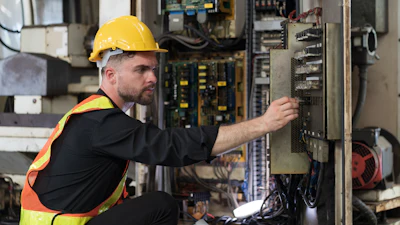
Maybe it's a Programmable Logic Controller (PLC). A proprietary control board. A sensor. A servo drive. The part itself isn't particularly valuable. Until it fails and you discover the OEM stopped making it eight years ago, there isn't a spare on the shelf and the closest replacement has a 20-week lead time.
That's when a relatively inexpensive problem becomes a very expensive one.
When we talk about operational risk in manufacturing, we naturally focus on the big things. Fires, hurricanes, cyberattacks, major equipment failures and supply chain disruptions deserve attention. But some of the vulnerabilities I find most interesting are the things we walk past every day and simply assume will be there tomorrow.
The machine isn't always the vulnerability
I've seen companies with excellent preventive maintenance programs discover that the real vulnerability wasn't the machine at all. It was an obsolete electronic component inside it that nobody had considered.
We tend to look at critical equipment based on replacement value. That's important, but operationally I am more interested in how long it would actually take to get that process running again.
Look inside the equipment. Is the OEM still supporting it? Are replacement controls available? Are PLC programs backed up? Is the software supported? Are there proprietary components? Does anyone other than the OEM know how to work on it?
Then look around it. What specialized tooling and utilities does it require? If you replaced the machine, would the new one fit? Would you need new electrical service, foundations, exhaust, compressed air or process cooling?
Ordering a replacement machine is not the same as recovering production. A machine may have a 30-week lead time, but add shipping, installation, programming, tooling, commissioning, validation and potentially customer approval.
Sometimes the critical asset goes home at 4:30
Most plants have a few people who know things. The maintenance technician who knows what to do when the old machine throws that strange fault. The engineer who remembers why a process changed ten years ago. The buyer who knows who to call when nobody else can find the part.
That knowledge has real operational value, and quite a bit of it may exist only in someone's head. I've walked through plenty of plants where, sooner or later, someone identifies a colleague as “the only one who knows how that thing works."
That's usually when I start asking questions. Who knows something critical to this operation that nobody else knows? The answers can be uncomfortable. They're also extremely useful.
Two suppliers don't necessarily mean redundancy
You may have two approved suppliers for a critical component and feel comfortable with the redundancy. But what if both purchase the same specialty material from the same source? Use the same heat treater? The same sub-supplier or overseas manufacturer?
On paper, you have two suppliers. Operationally, you may still have one dependency. For components that can shut down production, it makes sense to understand where the real dependency sits.
And there's another question: Can the alternate supplier actually handle your volume? Having an approved supplier isn't particularly helpful if that supplier can only absorb 10% of your demand.
Don't forget what supports the machine
Electricity gets plenty of attention in business continuity planning, and for good reason. But what happens when the plant loses compressed air? Process water? Natural gas? Industrial gases? Chilled water? HVAC? Internet connectivity? Dust collection? Depending on the operation, any one of those can stop production just as effectively.
A backup generator is great. It doesn't help much if the process can't operate without municipal water.
Technology creates similar dependencies. ERP systems, cloud applications, machine software, licensing servers, EDI connections and remote OEM support are now part of the production environment.
A backup isn't a backup until you know it works
"We have another machine." "We have another supplier." "We can move production to our other plant."
Good. Does the other machine have the correct tooling? Is there enough capacity? Does the other facility have the equipment and people? Is the process qualified there? Will the customer approve the transfer?
Redundancy can easily become a line in a business continuity plan that nobody has tested. A backup only becomes meaningful when we know it works.
Walk the plant and ask one question
Identifying these vulnerabilities doesn't always require another complicated assessment or spreadsheet. Walk the operation and ask: What if this disappeared tomorrow? Ask about the machine, the control board, the supplier, the maintenance technician, the software, the utility.
Then ask: How long can we operate without it? How long will it take to replace or recover it? What have we already done about it? The gap between how quickly something can stop the business and how long recovery takes is where the real vulnerability often lives.
Insurance can help finance a covered loss. But insurance and operational resilience aren't the same thing. Insurance can't manufacture an obsolete control board. It can't recreate 25 years of undocumented knowledge. It can't qualify a supplier overnight or turn a 40-week equipment lead time into 40 hours.
That's why I don't think the best risk conversations always start with, "What could go wrong?" Sometimes a better question is: What are we assuming will always be there?
The vulnerability that eventually stops production may not be the multimillion-dollar machine everyone is watching. It may be the ordinary thing right next to it that everyone stopped noticing.
Alush Garzon is the national managing director of manufacturing at Gallagher, a global insurance brokerage, risk management and consulting firm.