Across industries and geographies, manufacturers have begun to recognize the value artificial intelligence holds as a workforce multiplier and a tool to empower human beings.
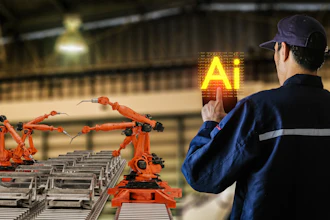
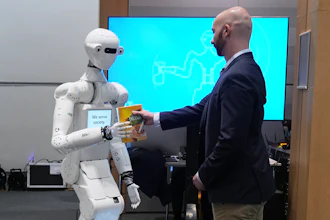
At its plant in Spartanburg, S.C., the auto manufacturer BMW piloted the use of humanoid robots driven by AI agents for highly demanding and exacting sheet-metal handling, positioning, and welding. Based on the success of that program, BMW plans to scale the use of physical AI—AI-enabled robots capable of learning—to manufacturing facilities in Europe. “The goal,” the company said, “is to relieve employees and further improve working conditions” by delegating monotonous, ergonomically demanding, or safety-critical tasks to these robots.
In Europe, a program called SKillAIbility seeks to advance human-centric approaches to AI and automation in manufacturing by exploring new models for human-AI collaboration in manufacturing to create more inclusive and sustainable workplaces.
The initiative, which involves 14 organizations across nine European countries, recently funded research that yielded a promising prototype for a real-time AI-powered assistive system to support deaf and hard-of-hearing individuals in industrial assembly, and workers in areas with high industrial noise. It combines haptic alerts, AI-driven live transcription, and visual assembly instructions into a single assistive tool.
I saw something similar during a recent visit to an industrial equipment manufacturer in Northern Germany. They’re using industrial robots, along with detailed guidance from a manufacturing execution system, to support workers with disabilities on the shop floor. The next step in the program, company executives told me, is to connect the robots to AI agents to turn it into an embodied AI deployment.
Use cases that combine multiple forms of AI—chatbots, agentic, physical/embodied—show the technology’s value as a workforce multiplier and a tool to support people in the workplace. Not only are multi-AI implementations performing more dangerous work to keep humans safe, they’re also creating opportunities to bring people into the workforce, an important consideration as a labor shortage continues to hamper manufacturers.
A recent report from Deloitte suggests it’s time for manufacturers to get serious about “combining AI technologies deliberately” to gain a competitive edge. “The question is no longer who has the most AI pilots. The question is who can replicate successful use cases across lines, plants, and regions with consistent performance, governance, and user adoption.”
Transforming Digital Intelligence Into Physical Action
Pilot and proof-of-concept (PoC) initiatives involving embodied AI are increasingly frequent within manufacturers’ production and warehouse facilities. Several notable examples:
- Martur Fompak International, a Turkish company that makes components for automotive interiors, is using an embodied AI robot from UK company Humanoid to collect, transport, and deliver materials between the warehouse and the production line. First generative AI interprets material requirements in real time, triggering an AI agent to begin orchestrating the robot. Meanwhile, other AI agents are gathering signals—from the supply chain, the production floor, about projected demand, etc.—to prioritize tasks, set sequencing and production priorities, and optimize robotic execution. The results have been promising enough that the company now plans to scale the AI-driven intralogistics model.
- In a test program at Bosch, a humanoid robot guided by agentic AI successfully handled intralogistics workflows across three distinct bin configurations and three workstation layouts based on real-time operational context, including delivery data, order priorities, and storage locations.
- Humanoid robots in a Vodafone Germany warehouse are detecting misplaced or damaged products, assessing pallet stacking and weight distribution, identifying unused storage space, and flagging potential hazards such as obstacles in aisles or misaligned pallets. The result is enhanced efficiency and safety in dynamic warehouse operations.
Embodied AI looks especially promising in manufacturing use cases like these because it can make autonomous, contextual decisions based on fresh data from the shop floor, the supply chain, customers and more. In pilot and PoC initiatives, it’s showing a strong aptitude for handling tasks involving a degree of unpredictability (in the task itself or in the task environment), including warehouse pick-and-place, asset inspection, health and safety inspection, quality inspection, and material handling and assembly.
By doing so, it’s enabling humans to focus more on problem-solving, engineering, production oversight, and supervision of AI outcomes.
Fundamentals to Succeed With Embodied AI
Successfully scaling pilots and PoCs like these is the next big step for embodied AI in manufacturing. That requires trusted data and data models that keep contextual information, along with strong human-in-the-loop AI governance in which AI models and their output are transparent, easily validated and readily auditable by human beings.
Training and upskilling people to understand and know how to manage the AI tools at hand, along with well-thought-out change-management programs, also are essential in scaling embodied AI. Deloitte’s report identified a lack of technical know-how and resistance to change as two of the top three biggest AI implementation challenges for manufacturers.
BMW noted that with its program, “the project team’s early communication ensured transparency from the outset and promoted acceptance. The deployment of humanoid robots was met with great interest among employees and quickly became a natural part of everyday work during the course of the project.”
Establishing this kind of healthy human-AI dynamic is key to tapping AI’s potential as a workforce multiplier on the shop floor, in the warehouse and across a manufacturing enterprise.
Andreas Grefenstein is a solution manager in SAP’s industry business unit for industrial manufacturing, aerospace & defense. Connect with him on LinkedIn here.