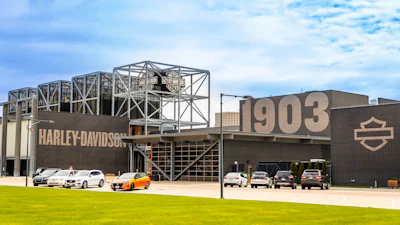
Last month, Harley-Davidson announced plans to reshore production as part of the company's new "Back to Bricks" strategy. The motorcycle maker's move to bring machining, powertrain assembly, painting, and final vehicle assembly work back to facilities in Pennsylvania and Wisconsin was heralded by the industry, and the Trump administration called it an "American manufacturing win!"
The strategic shift will introduce more affordable models that attract new riders. However, while the new models, as well as the highly anticipated return of the Sportster, could boost retail sales momentum when they hit the market, analysts at S&P Global think it could take several years to sustain retail sales and wholesale unit shipments growth sufficient to stabilize its S&P Global Ratings-adjusted EBITDA margin near 10%.
S&P forecasts that operating income and EBITDA margin will remain depressed through at least 2027, with adjusted EBITDA margin (including operating losses at LiveWire) of 5% to 6% in 2026, as the company prioritizes market share over unit profitability.
As a result, the S&P lowered the motorcycle maker's credit rating from BBB- to BB+, a downgrade from a medium-risk investment opportunity to high-risk junk status.
While the company aims to reduce costs by $150 million, which should bolster 2027 operating income, S&P said this year's operating income is under pressure due to ongoing restructuring expenses. For example, in the first quarter, the company incurred $15 million in charges related to its strategic shifts, including headcount reductions and employee termination benefits. In March, Harley-Davidson notified an undisclosed number of workers that it would reduce its global workforce.
Furthermore, the company anticipates tariff costs, primarily on steel and aluminum, of $75 million to $90 million, a slight reduction from its February 2026 forecast of $75 million to $105 million. Management expects to experience peak tariff effect in 2026, as recent changes to trade policies and new exemptions for certain motorcycle parts should alleviate these pressures beyond 2026, according to S&P.
Harley’s Bet on Lower-Priced Bikes
Harley has maintained its position as an aspirational brand for riders, with motorcycles costing up to $50,000. S&P said the company has leaned into premium products to increase operating margin and unit profitability since 2020. This provided pricing power but left gaps in the market for entry-level riders, ultimately resulting in fewer sales and hurting its dealer base.
Under the new plan, Harley will introduce its Sprint model and reintroduce its Sportster model, which it discontinued in 2022. Starting in late 2026 and 2027, both models will sell at entry-level price points of around $10,000 for Sportster and less for Sprint.
Harley’s management noted that dealerships have routinely expressed their desire for lower-priced models—the Sportster in particular.
Assuming the U.S. motorcycle market remains relatively flat compared to 2025, Harley could increase its market share to the mid-40% range, primarily through new product introductions, especially the reintroduction of its Sportster, S&P said.
Still, S&P remains “cautious” when it comes to the long-term sustainability of U.S. motorcycle sales growth, noting that it could take Harley several years to regain lost market share. Since 2019, Harley’s market share in the U.S. declined to 34.5% in 2025 from 49.1%, as measured by total motorcycle registrations. S&P added that a significant portion of the decline occurred immediately after the Sportster's discontinuation.
Part of S&P’s outlook depends on the long-term health of the heavyweight segment, which remains unclear. Between 2019 and 2025, Harley maintained its share above 70% in heavyweight categories even as its overall share declined, partly driven by a shift in consumer preferences toward smaller motorcycles.
S&P also lowered its short- and medium-term rating on Harley-Davidson Financial Services Inc. (HDFS).
Despite the many potential challenges facing the motorcycle maker, the S&P said the manufacturer’s outlook remains stable due to Harley’s robust liquidity and commitment to maintaining low debt-to-equity levels. S&P also anticipates modest improvements in retail and wholesale volumes, with S&P Global Ratings- and captive-adjusted EBITDA margin expanding to high-single-digit percent over the next two years as the company completes its restructuring this year, enhancing operating leverage.
IEN reached out to Harley-Davidson, but the company has not responded to our request for comment.