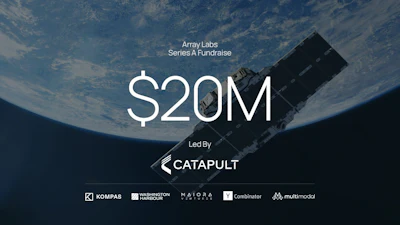
Array Labs today announced a $20 million in funding to help build what it believes is the first radar architecture capable of being mass-manufactured using techniques borrowed from consumer electronics and telecommunications.
It's an approach the company said has allowed it to collapse traditional cost structures while increasing performance.
"The radar satellite industry today looks like space launch before SpaceX: dominated by legacy defense contractors building bespoke, expensive systems one at a time," said Array Labs CEO Andrew Peterson in a statement. "We've assembled a team from the most innovative technology companies in Silicon Valley to do something different: build radar that can be produced at scale, at commercial price points, without sacrificing capability."
In 2025, Array Labs doubled the size of its team, completed the design of its satellite bus, formed two new product lines, and grew commercial bookings to nine digits in contracted revenue. The company has also been selected for roughly half a dozen government awards over the last 24 months, across the U.S. armed services, intelligence community, and key combatant commands.
Array's original goal was launching clusters of small satellites that cooperatively image to create a real-time 3D map of Earth. But after realizing the radar instruments it had built were attractive to customers on their own, the company changed from a vertically integrated remote-sensing data provider into a radar-first platform business.
Over the last two years, Array has been selected for several competitive U.S. government awards across the Air Force, Space Force, Navy, Army, U.S. Special Operations Command (SOCOM), and the Defense Advanced Research Projects Agency (DARPA) to advance the state of the art across high-power antenna architectures, high-bandwidth communications links, 3D reconstruction algorithms, and more.
On the commercial side, Array has signed multi-year capacity agreements for its first radar cluster with companies specializing in mining, infrastructure, and embodied AI. These customers will use Array's 3D data and downstream analytics to monitor industrial sites, plan and protect infrastructure, and feed better ground-truth information into autonomous systems.
Array said it has built radar that is powerful enough for global detection and tracking missions like Golden Dome, packaged in a way that partners can quickly integrate and field new capabilities. These systems are further improved by Array's advanced AI-driven software, which transforms raw radar readings into actionable 3D intelligence rather than folders of static imagery.
With this Series A financing, Array will scale its engineering, product, and go-to-market teams; expand production capacity and meet growing demand for its radar panels; complete flight qualification; and ultimately, launch the world's first formation-flying radar satellite cluster.
The Series A financing round was led by Catapult Ventures, with participation from Washington Harbour Partners, Kompas VC, and other new and existing investors, including Y Combinator, Maiora Capital, Animal Capital, Aera VC, Cultivation Capital, and Clearance Ventures. The round brings Array's total funding to $35 million since going through Y Combinator. The company previously raised a $5 million seed in 2022 after completing YC, followed by a $10 million round in 2024.