Cloaking technology traces its roots to metamaterials, which Duke University describes as artificially structured materials used to control and manipulate light, sound and other physical phenomena. The history of metamaterials stretches back over a century, including a 1919 patent by electrical engineer Guglielmo Marconi and a colleague. Resonant metamaterials were later used for partial concealment in the U-2 spy plane.
Decades later, Nathan Cohen, the CEO of Fractal Antenna Systems, discovered a curved fractal-based metamaterial microwave array could produce “front scatter,” which he said provided the physical basis for cloaking.
In this Q&A with Manufacturing.net, Cohen explains how electromagnetic cloaking works, where he sees the technology progressing and the challenges that come with making objects harder to detect.
Responses have been edited for length and clarity.
Nolan Beilstein (NB): When discussing an electromagnetic invisibility cloak, what does “cloaking” actually look like in practice?
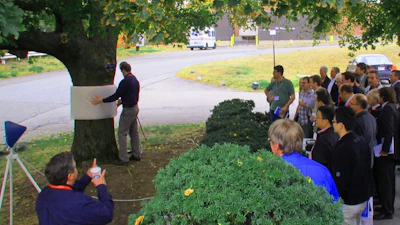
Nathan Cohen (NC): An electromagnetic cloak does not look like a Harry Potter cape. It can be surprisingly ordinary-looking: thin bands or layers containing arrays of tiny resonators, fabricated on conformable circuit-board material, plastic films or other thin substrates and arranged around the object being cloaked. Depending on the frequencies involved, the cloak might look like patterned rings, sheets or shells. Most invisibility cloaks are in the radio frequency (RF) or infrared wavelengths.
What is extraordinary is what those layers do. Instead of electromagnetic waves hitting the obstruction and being blocked, reflected or scattered, the cloak guides the waves around it and brings them back together on the other side. The blockage effectively disappears because the electromagnetic energy slips around the object and continues on its way.
 Fractal Antenna Systems
NB: What is the biggest misconception you often hear about what electromagnetic cloaking can accomplish?
NC: Visible-light “cloaks.” The ones you sometimes see online are not the same thing as a true electromagnetic cloak. Lenticular lenses and related optical tricks can hide an object from a very limited viewing position, but that is more of a parlor trick than true cloaking. Move the object or change the angle, and the illusion falls apart. These “cloaks” are similar in construction to “winky rings” that come in gumball machines, only scaled up.
A real visible-light cloak is much harder because visible wavelengths are so short and the tolerances become extremely demanding. But I do think genuine visible-light cloaking is coming, and I would expect meaningful demonstrations within the next five years.
NB: Which potential applications concern you the most?
NC: Those that allow people or objects to be hidden without anyone knowing they are there. Drones, for example, obviously have military implications. But there are also surveillance, security and privacy issues.
Once you can conceal something from a sensor, or eventually from human vision, you also have to think about how to detect that concealment. That is why counter-cloaking technology is important too.
Also, visible-light cloaking could become an invitation to dangerous and rapidly escalating conflicts. I am much more interested in making sure we can detect a visible-light cloak than in helping make one harder to find.
NB: Where do you see electromagnetic cloaking making the biggest impact in 10 to 20 years?
NC: The biggest impact will come from practical uses that make wireless systems work better in the real world. One example we are likely to see much sooner than 10 or 20 years is in the Internet of Things. Mesh networks will increasingly connect large numbers of devices, but inside buildings those signals are constantly being blocked or distorted by pillars, walls, equipment, furniture and other obstructions.
If RF energy can be made to slip around those obstacles, the network becomes more reliable. You need fewer repeaters and access points, installation gets cheaper and coverage improves. Over the longer term, I expect cloaking concepts to show up anywhere electromagnetic waves are being blocked, scattered or redirected in ways we would rather control—communications, sensing, imaging, transportation, defense and eventually visible-light applications as well.
Based in Bedford, Massachusetts, Fractal develops advanced antenna, array, metamaterial, space and electromagnetic technologies for commercial and government applications.