TORRANCE, Calif. - K2 Space, a California-based developer of large, high-power satellite platforms, has announced a $250 million Series C at a $3 billion valuation, accelerating delivery of a new generation of spacecraft built for the heavy-lift era. The financing follows $500 million in signed contracts across commercial and U.S. government customers.
K2 was founded in 2022 on a single thesis: the rise of launch vehicles like Falcon 9, Starship and New Glenn will make it possible to build an entirely new category of satellite. Satellites that are larger, higher power and more reliable; that can be deployed in any orbit – LEO, MEO, and GEO – rather than confined to one. These capabilities will become increasingly important as critical applications like communications and compute get pushed from terrestrial networks to space.
K2's first two years were spent solving what the commercial supply chain hadn't: the foundational subsystems required for large, high-power, highly resilient spacecraft. The team designed the highest power hall-effect thruster ever flown – 4x more powerful than anything that's flown to-date; large solar arrays, designed to reliably generate maximum power; a radiation-tolerant avionics suite built to survive high radiation environments; massive reaction wheels; high voltage power systems; and much more.
Those designs weren't just theoretical. Earlier this year, K2 flew its hardware as part of a hosted-payload mission that validated the flight computer, reaction wheel, and avionics stack in space, de-risking the core of the platform ahead of full-system integration.
In March 2026, K2 will launch GRAVITAS, the company's first production of its "Mega Class" satellite. While small relative to what K2 is designing next, the Mega Class satellite is on par with the largest satellites that have ever been produced. Mega is designed to fly on today's workhorse rockets, including Falcon 9, Vulcan, and Ariane 6, while delivering approximately 10× the power of other satellites in its class. Built from the outset for multi-orbit operations, Mega is hardened for some of the harshest environments in the solar system and engineered with redundancy and reliability techniques historically reserved for human-rated vehicles like Dragon and the Space Shuttle.
The mission represents K2's first spaceflight of the fully integrated, in-house system and will open a comprehensive test campaign:
- The first in-space firing of a 20 kW Hall-effect thruster – roughly 4× more powerful than anything flown to date.
- The first deployment of the large twin 10 kW solar arrays on the platform (20kW total).
- The first on-orbit exercise of K2's high-voltage power system paired with radiation-tolerant avionics.
"GRAVITAS brings our full stack together for the first time," said Karan Kunjur, Co-Founder and CEO. "We are validating the architecture in space, from high-voltage power and large solar arrays to our guidance and control algorithms, and a 20 kW Hall thruster, and we will scale based on measured performance."
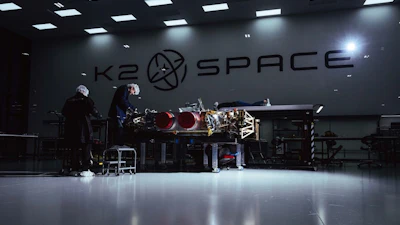
Following Mega's launch, K2 will ramp manufacturing at its 180,000 –sq.-ft. Torrance factory, sized to produce 100 high-power satellites per year. That capacity will be needed as K2 starts delivering against $500 million in signed commercial and government contracts. Customers include large operators like SES, who recently announced plans to partner with K2 on its future MEO network. Multiple launches across 2026-2027 are planned, with operational commercial and national security constellations beginning deployment starting in 2028.
With Mega establishing the production baseline, K2 will next unveil plans for designing Giga: its large-class spacecraft designed specifically for Starship and New Glenn. Giga will deliver 100kW of power per satellite, enabling missions that previously only existed in science fiction:
- AI scale compute on orbit
- High-throughput networks spanning orbits – and planets
- Mass-produced giant telescopes to vastly expand scientific return from across the solar system and beyond