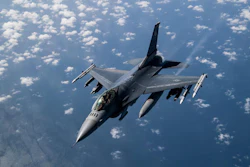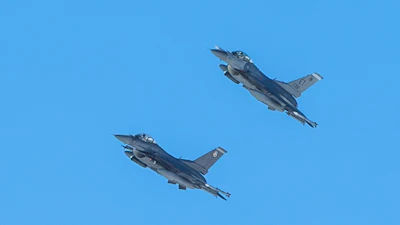
On their own, Northrop Grumman’s Integrated Viper Electronic Warfare Suite (IVEWS) and Scalable Agile Beam Radar (SABR) Active Electronically Scanned Array (AESA) radar are formidable capabilities for the F-16. Together they provide advanced survivability and lethality for the Viper.
Fighter jet radars and electronic warfare (EW) protection systems use the radio frequency portion of the electromagnetic spectrum for targeting, self-protection and surveillance missions. From the start, Northrop Grumman designed the F-16’s IVEWS to work with the SABR AESA radar, so that both could use the same portion of the spectrum simultaneously.
James Conroy, vice president of electronic warfare and targeting, said, “Dominating the electromagnetic spectrum paves the way for all other operations. In these high-stakes environments, having systems that work together is a significant advantage that allows warfighters to operate safely and effectively in the highly contested airspace of a near-peer fight.”
There is no filtering, blanking or reduction of the radar’s capabilities while IVEWS protects the platform. The two systems communicate digitally on a pulse-to-pulse basis, so each is aware of what portion of the spectrum the other is using at every moment. Pilots can carry out intense radar tasks without compromising the ability of IVEWS to counter adversary threats.
“We built IVEWS with an ultra-wideband architecture and the onboard power to detect and protect against the most advanced threats,” said Conroy. “The U.S. and its international partners are encountering these same threats worldwide.”
IVEWS was selected by the U.S. Air Force in 2019 and has since completed Operational Assessment, flying more than 70 sorties in complex electromagnetic spectrum environments. Northrop Grumman has delivered over 900 SABR systems since 2013.
At the Air Force’s Northern Lightning exercise in 2021, IVEWS flew together with SABR in a highly congested electromagnetic spectrum environment against airborne and ground-based threats. It would undergo rigorous laboratory and chamber testing before being installed on two USAF F-16 aircraft and completing Developmental Test and Operational Assessment.
Since completing Operational Assessment, IVEWS has continued to fly against a wide range of airborne, maritime and ground-based threats, demonstrating its ability to preserve the freedom of maneuver and protect warfighters. To date, it has amassed more than 250 flight hours.