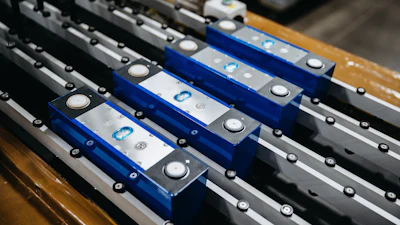
The first lithium iron phosphate (LFP) prismatic battery cells are rolling off the line at BlueOval Battery Park Michigan and headed to Louisville Assembly Plant to power Ford Fathom prototypes. With this milestone, Ford is now in the battery business and will be the first to deliver LFP batteries in the U.S. for mainstream consumer automotive use.
The shipment caps years of work by the team that designed, built, and launched the plant on schedule. Ford now delivers cells at a plant it owns and operates, building expertise to support more affordable electric vehicles (EVs) and Ford Energy’s battery energy storage business in Kentucky.
Why Start with LFP Prismatic for Fathom?
When Alan Clarke, vice president, Advanced Development Projects, first joined the development team that created the Universal Electric Vehicle Platform, he issued a clear challenge: find an efficient LFP prismatic battery. The goal was to make EVs significantly more affordable.
We talked to battery companies around the world. We wanted a technology that was proven in the field, ready to manufacture at scale, and suited to what we were building. That led us to the world’s leading battery manufacturer, CATL, whose batteries power 30 million vehicles across the globe.
A battery is one of the biggest contributors to an EV’s cost and weight. So, we asked: How do we get more out of the battery without simply adding more cells? Our answer was efficiency over excess.
LFP chemistry uses no nickel or cobalt, which helps hold down costs. It also holds up over years of charging and use. That durability is valuable as we give customers ways to use their battery beyond driving. For example, AC bidirectional power lets a vehicle receive electricity from a properly equipped home and supply power back to it.
We engineered Fathom for efficiency, too, right-sizing the battery and putting every electron and part to work.
Making the battery pack part of the vehicle structure is a key example. Rather than simply housing the battery pack within the vehicle, we designed it to serve as a structural component. We chose prismatic, or rectangular, cells because they fit directly into the chassis and cut structural costs.
We also combined electrical and sensing connections into a flexible circuit board and integrated compact power electronics into the pack. This architecture helps enable the new Universal EV Production System.
Our rule: The best part is no part, and the second-best part is one that serves multiple purposes. Fewer parts mean less weight and simpler manufacturing. Those details matter because they bring us closer to our goal: delivering an EV with the performance customers expect at a price that convinces drivers of gas-powered vehicles to make the switch.
 Ford
Delivering with Quality at Scale
Making a battery cell is one thing. Delivering high-quality cells consistently, at the required scale and pace, is another.
The BlueOval Battery Park Michigan assembly lines can deliver 40 cells every minute, making it among the fastest LFP prismatic battery assembly lines outside of China. That pace helps drive down battery costs, and the facility has capacity for more. But speed must go hand in hand with quality.
Employees use AI-powered image recognition and other tools to spot defects during production. Our goal is to make defective cells so rare that we track their frequency per billion cells rather than per million.