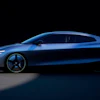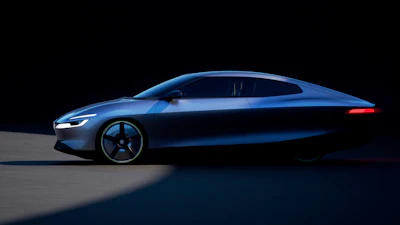
Volkswagen's newly unveiled electric concept vehicle is breaking records for aerodynamics and efficiency. But the automaker said it's doing it with available platforms instead of specialty technology, meaning its achievements could show up in production vehicles sooner rather than later.
The company said the Mission Efficiency prototype has set three records: one for drag in a road-approved vehicle, one for energy consumption during an "ideal roadtrip" with no uphill slopes and peripheral consumers like air conditioning, and one more for being the "most economical near-production electric car in its class."
 Volkswagen
On a consumption test drive over a distance of 1,278.36 kilometers (about 794 miles) from Volkswagen’s German Development Centre in Wolfsburg via Poznań (Poland) and Olmütz (Czech Republic) to Vienna, the Mission Efficiency achieved real consumption of 7.51 kWh/100 km including charging losses (6.89 kWh/100 km without charging losses).
The route was completed with an average speed of 67.72 km/h (about 42 mph); the top speed was 138 km/h (nearly 86 mph). The 54.9 kWh battery was only charged once during the journey. On arrival in Vienna, it had a remaining range of 164 kilometers (approximately 102 miles).
The Mission Efficiency features a flow-optimized teardrop shape, small frontal area, active cooling air flaps, clad rear wheels and a fully clad underbody. The doors to the Mission Efficiency feature frameless windows, while the door handles have been integrated into the outer skin for optimum air flow. The vehicles also includes changes to the wheel placement to reduce turbulence, and a concept tire co-developed with Continental to minimize energy losses while rolling.
The design works particularly well at high speeds, where consumption is more than 30 percent lower than in the standard version of the ID. Polo.
 Volkswagen
The four-seater includes storage in the trunk, under seats and in side panels. A photovoltaic system with a power output of 370 W is integrated into the glass roof and boot lid, and supplies power to the on-board electrical system’s consumers. Volkswagen said that, depending on the season, region and weather, it can increase the real range by up to 30 kilometers (nearly 19 miles) per day.
On the inside, the designers used lightweight panelling, a mobile Bluetooth box instead of a speaker system and a “bring your own device” concept to reduce the weight. It means a smartphone or tablet takes the place of the infotainment system display.
“Mission Efficiency is the ideal way to demonstrate what distinguishes Volkswagen in the electric age: technology for the masses – not just for the few. Rather than using specialist technology, the vehicle set its three world records using affordable production technology from the ID. Polo and ID. Cross, based on the MEB+ platform with front-wheel drive. This shows how much potential efficiency we can add to the latest generation of our electric cars. Developed in Wolfsburg and built by Kai Grünitz and his team, the Mission Efficiency is a symbol of German engineering expertise with clear customer benefits," said Thomas Schäfer, CEO of the Volkswagen brand, in a statement.
 Volkswagen