From the first creative design sketch, to final validation, to launch readiness, GM is reimagining the vehicle development process around a more connected, virtual-first model — one that uses AI, simulation and decades of engineering data to compress feedback loops and reduce physical iteration.
Traditionally, vehicle development worked like a sequential relay race with multiple interdependent handoffs across functions. It’s a complex model built on deep coordination, where each team advances the work and hands it forward with little room for error. In that kind of engineering system, dropping the baton is not a minor miss – it can have major consequences across the program.
GM is building something different now: A concurrent development system wherein more teams can work from the same digital foundation at the same time. Designers, aerodynamicists, software teams, controls engineers, safety specialists and manufacturing experts can increasingly learn from the same model, allowing them to react faster to changes and make better decisions earlier in the process.
This is bigger than any one AI tool. It is a shift in operating model, evolving from disconnected phases to a single integrated digital thread spanning design, engineering, validation and manufacturing. In a software-defined era, that kind of zero-lag iteration is becoming a competitive advantage.
And while the approach is virtual-first, it is not virtual-only. Physical testing remains essential. The difference is that physical validation becomes more targeted and informed.
 Occupant and vehicle-system simulation data show how motion moves through the cabin in dynamic conditions, helping engineers evaluate response and refine performance.General Motors
From handoffs to concurrent engineering
One of the clearest signs of that shift is the move from sequential handoffs to concurrent engineering. Instead of waiting for one function to finish before another can respond, teams can increasingly work in parallel, with faster feedback loops and fewer late-stage surprises.
That dynamic now starts at the earliest stages of development. GM is embedding AI into workflows from the first sketch onward to help teams refine ideas sooner. Human creativity still sets the direction while AI helps expand design-space exploration by making it possible to generate more variations, evaluate them earlier and focus more time on the choices that matter most.
For example, a designer can now start with a hand-drawn concept sketch and use AI to quickly produce a series of images and teaser animation, compressing a process that traditionally could have taken months into less than a day.
That same principle extends directly into aerodynamics. GM’s AI-powered virtual wind tunnel allows designers and aerodynamicists to evaluate how surface changes affect drag in real time, rather than waiting days or weeks for traditional feedback cycles. The result is not just faster work; it’s real time tradeoff analysis, tighter collaboration and better-informed design decisions while the creative work is still happening.
The digital thread continues deeper into engineering through co-simulation, or “co-sim," which links physics-based plant models with virtual controllers in a closed-loop environment. That enables teams to validate how software and hardware behave together before physical hardware is ready. This accelerates development in areas like controls, dynamics, thermal behavior and powertrain calibration.
And in safety and structural development, virtual crash simulation is compressing learning cycles on a fundamentally different scale. Using advanced machine learning and simulation, GM can cut roof crush analysis runs from 8-40 hours to less than five minutes, enabling far more iterations and edge cases before costly physical testing begins.
Extending the digital thread into manufacturing
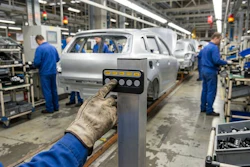
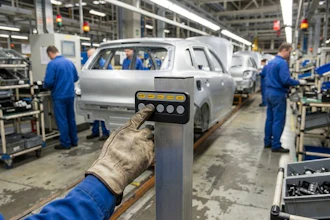
In manufacturing engineering, immersive XR technology helps close the gap between CAD on a screen and the real world. Teams can now review assembly sequences virtually, identify potential ergonomic issues and evaluate the latest design iterations without waiting for 3D-printed or prototype hardware to validate their ideas.
Teams can now run equipment virtually, bring maintenance and operations personnel into reviews earlier, improve safety and ergonomic evaluation and use augmented reality (AR) to overlay equipment on the plant floor. This allows engineers to validate the positioning, clearance and access to manufacturing tooling before installation.
These virtual workflows help our plants get operational faster and with fewer late surprises, shaving weeks off our traditional mean time to commission.
 Co-simulation data shows how steering, braking, rear-wheel steering and roll control work together to support stability, path control and vehicle handling.General Motors
A new development architecture for a software-defined era
Speed alone is not the goal. When a virtual foundation can inform design, vehicle performance, system integration, software and services, vehicle safety, manufacturing readiness and many more disciplines, GM is able to replace disconnected loops with more continuous ones. That means fewer handoffs and fewer blind spots between disciplines.
AI and virtualization are creating a more intelligent vehicle development system. One where decades of proprietary data, advanced simulation environments and domain expertise combine to make every program smarter. As the industry moves toward faster iteration, software-defined architectures and greater complexity across the product lifecycle, virtual development is becoming more than an engineering capability.