Due to their intricacy, traditional inspection processes are often conducted manually and limited to spot checks. However, Vista Solutions Inc.—with offices in Canada, the U.S. and Mexico—introduced a solution designed to address that: the Flex-Inspect Platform.
This automated inspection system leverages advanced machine vision to perform comprehensive measurements of automotive underbody trays, enhancing both accuracy and throughput. The machine vision software powering this platform is MVTec HALCON, developed by Germany-based MVTec Software.
 MVTec Software
From Sci-Fi to Shopfloor: Turning Advanced Vision Concepts into Real-World Applications
Technologies like Surface-Based Matching, Sheet-of-Light and Edge Extraction may sound like science fiction, but they’re revolutionizing industrial automation today. These machine vision technologies are an essential part of Vista’s solution for the automotive sector.
The system conducts True Position Measurements (TPM) on key features of underbody tray assemblies. 2D cameras mounted to robotic arms capture images of relevant inspection points. These images are then analyzed by MVTec HALCON, which performs detailed measurements, such as width, depth, distance and thickness, of critical part features. HALCON also assists with robot path planning to ensure optimal camera positioning for each inspection.
Founded in 2003 and headquartered in Windsor, Ontario—with offices in Detroit, Michigan and Querétaro, Mexico—Vista Solutions develops turnkey machine vision systems for the automotive, road safety and defense industries. Their portfolio includes consulting, implementation and end-to-end customer support.
 MVTec Software
Machine Vision: A Quiet Powerhouse in Automotive Manufacturing
Machine vision has become a key driver of automation in manufacturing, often described as a “hidden champion.” Why? It provides unmatched scalability, precision and 24/7 uptime. Unlike human inspectors, vision systems don’t tire, vary in performance or require breaks, making them ideal for repetitive inspection tasks.
In Vista’s case, the Flex-Inspect Platform was developed as an inline inspection solution for an automotive supplier, replacing a previously manual process. The objectives were clear:
- Achieve 100% inline inspection for consistent, real-time quality validation
- Reduce inspection time to fit within the production cycle
- Free up skilled workers for higher-value tasks
“A machine-vision-based system was the only viable option to meet these goals,” Vista Vice President of Engineering Peter Denzinger said. “Vision systems offer exceptional flexibility, rapid deployment and, unlike sensors, they remain reliable even when positioning isn’t perfectly consistent.”
 MVTec Software
Automated Inspection in Action: Robots, Cameras and Deep Image Analysis
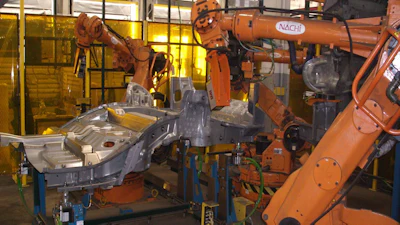
Built around MVTec HALCON, Vista’s Flex-Inspect Platform integrates a robust hardware setup: two 6-axis robots, each equipped with a 3D snapshot imager. These imagers combine industrial cameras with ring lights and laser projectors, enabling the creation of detailed 3D images of the part surface.
HALCON is deeply embedded in Vista’s control software and performs multiple core functions, starting with hand-eye calibration. This process aligns the coordinate systems of the robot and the vision system, a prerequisite for accurate part localization and measurement.
HALCON’s operator library, comprising over 2,100 image processing tools, was a key factor in Vista’s software selection.
“We’ve been working with MVTec since 2008,” Denzinger said. “For this project, HALCON offered the breadth of functionality and platform independence we needed.”
Once the underbody tray is positioned within the robotic work cell, both robots independently navigate to predefined measurement points. The system determines the real-world position of each datum and critical feature to execute TPM checks. The result is a clear pass/fail output, based on whether each measurement falls within acceptable tolerance limits.
To meet the tight cycle times required by modern production, each image must be processed as a snapshot in real-time.
 MVTec Software
Advanced Image Processing – From Pixel to Precision
What role do techniques like Surface-Based Matching, Sheet-of-Light and Edge Extraction play?
- Surface-Based Matching robustly and precisely identifies the relevant object within the camera’s field of view, forming the foundation for further analysis.
- Sheet-of-Light enables accurate 3D surface reconstruction by calculating height profiles using laser lines, which are then merged with 2D images to create high-resolution 3D profiles.
- Edge Extraction detects object boundaries at sub-pixel accuracy by identifying abrupt changes in image brightness or color, essential for reliable part feature definition.
These operations are repeated for every key feature of the part. Once all features have been measured, the system can perform fixture-based measurements or calculate 3D offsets for alignment and guidance purposes.
“HALCON’s extensive library allows us to select the best-fit method for each task,” HALCON Product Manager at MVTec Jan Gärtner said. “That flexibility is crucial for manufacturers who need a system that can scale and adapt to a wide range of applications.”
 MVTec Software
Delivering Real Business Value Through Automated Quality
Vista’s solution has already been deployed for a full production cycle.
“We stayed in close contact with the client post-implementation and made sure that all strategic targets were hit,” Denzinger said. “The improved and consistent part quality gives them a clear competitive edge.”
Looking ahead, Vista and MVTec see increasing demand for intelligent inspection solutions, especially in automotive manufacturing, where AI-driven vision applications are poised to grow.
“Vista’s solution is a great example of how machine vision can create measurable value,” Gärtner said. “By automating inspection, companies not only improve consistency and throughput, they also reduce labor strain and gain flexibility. It’s a clear win across the board.”