Commercial aerospace is entering one of the most ambitious production ramp-ups in its history. Airbus and Boeing are sitting on a combined order backlog of >15,000 aircraft, providing years of production visibility but also placing unprecedented pressure on the global manufacturing ecosystem. As OEMs work to increase build rates, every tier of the supply chain – from raw material producers to forging houses – is being pushed to deliver higher volumes without compromising quality or lead times.
For manufacturers of critical components such as engine shafts, landing gear cylinders and large structural parts, that journey begins with a manufacturing process that determines the component's mechanical integrity long before it reaches a machining center – open-die forging.
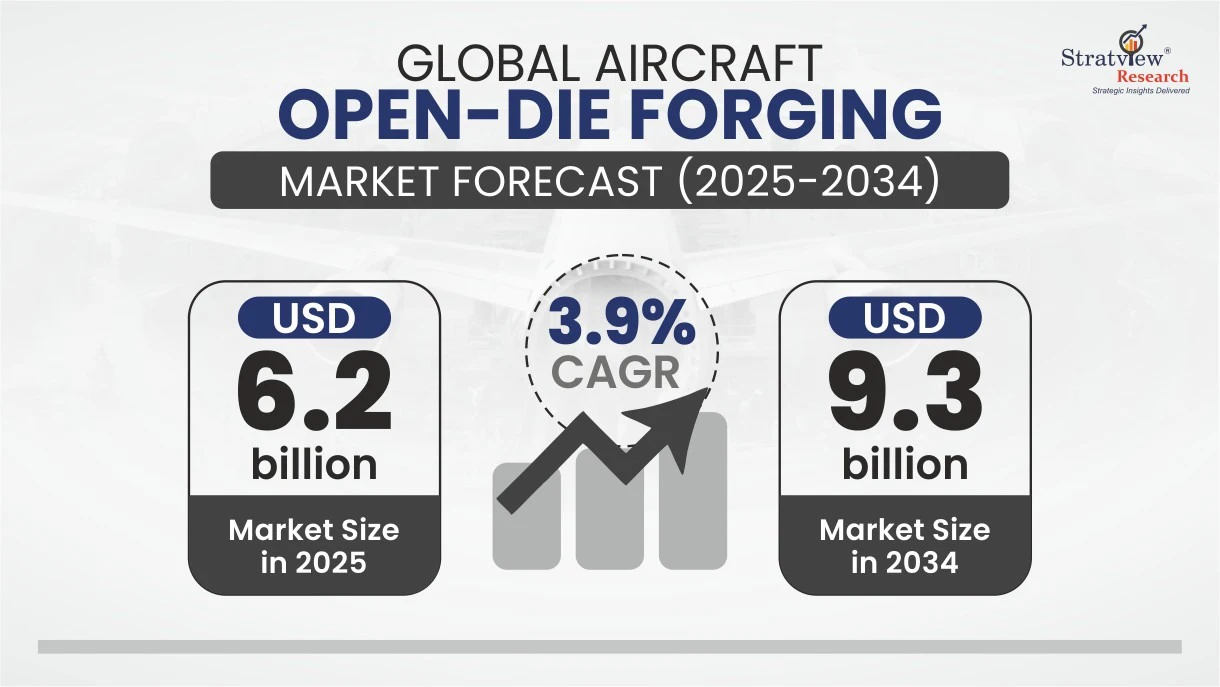
Unlike casting or fabrication processes that may introduce internal defects or inconsistent grain structures, open-die forging refines the metal's internal grain flow, producing components with superior strength, toughness, fatigue resistance and reliability. Its strategic importance is becoming increasingly evident as demand rises not only in aerospace but also across defense, energy, heavy equipment and industrial machinery. Reflecting this momentum, the global aerospace open-die forging market expanded from approximately $5 billion to $6.2 billion within just three years, reaching that level in 2025 and is projected to surpass $9.3 billion by 2034. Let’s see how and what’s driving this surge.
 Stratview Research
How Open-Die Forging Shapes Modern Aircraft
Open-die forging has remained relevant for decades because few manufacturing processes can match its combination of strength, scale and metallurgical integrity. Because this process does not require complex or custom-machined impression dies, it delivers exceptional cost savings, shorter lead times and high material versatility for custom or low-volume runs.
Instead of pouring molten metal into molds or machining parts from solid stock, the process compresses heated metal between flat or contoured dies, refining its internal grain structure while shaping some of the strongest structures. Unlike casting, open-die forging produces defect-resistant components while minimizing material waste. The absence of dedicated dies also makes it economical for low-volume production, large custom parts and components that exceed the size limits of closed-die forging.
Aerospace industry remains the most demanding and strategically significant user of open-die forgings, where the process forms the starting point for many of some aircraft's most critical components. And across aircraft types, commercial aircraft account for >70% of the open-die forging market. Growing passenger travel, expansion of low-cost carriers (LCCs), continued fleet renewal and rising global aircraft demand sustain these higher production requirements, translating into greater demand for open-die-forged engine shafts, turbine and compressor discs, landing gear components, structural rings and large airframe forgings.
As per Stratview Research, a substantial share of aerospace open-die forgings – close to three-fourths – is consumed by engine components’ manufacturing, that operate under extreme temperatures, rotational loads and repeated fatigue cycles, requiring high material integrity and resistance to internal defects. Open-die forging is well suited to these requirements because it refines the grain structure and improves mechanical properties in large, highly stressed components.
However, open die forging isn’t a one-size-fits-all process. It’s typically best for larger parts that can be shaped through repeated hammer or press operations – not always for small, intricate components requiring tight tolerances or complex internal geometries. The market numbers are also depicting the same picture. Only a small fraction – around 15%-20% of open-die forging applications are dedicated to smaller aircraft components. The technology overwhelmingly serves the production of large, high-value structural parts.
Nickel Superalloys: The Material Powering Modern Aircraft Engines
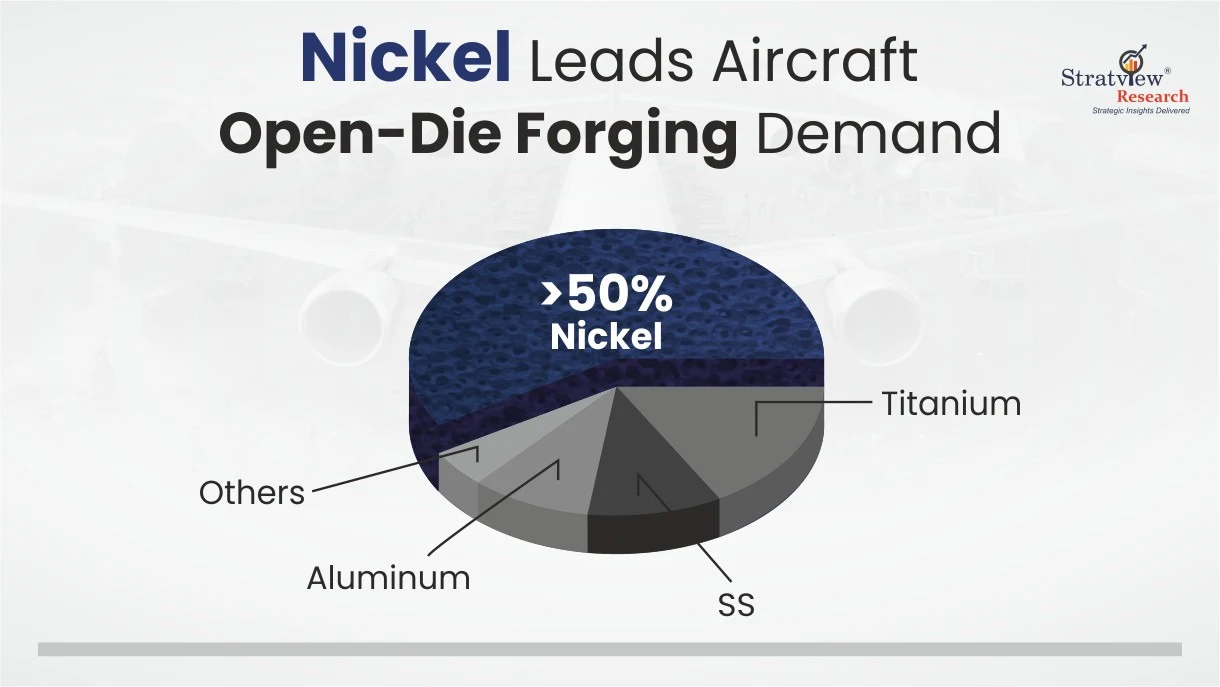
Performance starts at the molecular level. Common choices include titanium, stainless steel and aluminum and nickel alloys. While each alloy serves different industries, aerospace places the most demanding requirements on material performance. The heat inside the combustion chamber of a rocket or turbine engine can create a hellscape for metal components, with temperatures often exceeding 1,000 degrees Celsius. To ensure components can withstand the heat, engine manufacturers have long relied on nickel-based materials.
 Stratview Research
Nickel alloys and superalloys are preferred for components operating above 700°C, where they must withstand severe mechanical stresses while resisting creep, oxidation, fatigue and hot corrosion.
NASA has extensively documented René 95 as a powder metallurgy nickel-base superalloy developed for high-pressure turbine disks because of its exceptional creep and fatigue strength. Also NASA uses Inconel 718 (IN718) for rotating aircraft engine components like engine shafts, turbine disks, impellers, rotors, etc.
Commercial engine manufacturers have followed the same approach. GE Aerospace uses forged nickel superalloys in turbine disks and shafts for its GE90, GEnx and GE9X engines. Rolls-Royce applies them to turbine discs and shafts across its Trent family, while Pratt & Whitney employs these superalloys in the hot-section rotating hardware of its PW1000G Geared Turbofan engines.
Nickel may dominate aircraft engines, but it is far from the only alloy processed through open-die forging. Titanium alloys are favored for open-die forged compressor and structural components because they combine low weight with excellent corrosion resistance. High-strength steels continue to support landing gear and other high-load applications, while aluminum alloys are used for large structural forgings where weight savings directly improve aircraft efficiency.
North America Continues to Set the Pace
North America accounts for over half of the global aircraft open-die forging market, largely supported by its extensive aircraft and component manufacturing base. The region brings together nearly every critical link in the value chain – from aircraft and engine manufacturers such as Boeing, GE Aerospace, Pratt & Whitney and Lockheed Martin to specialized forging companies including Scot Forge, Wyman-Gordon (PCC), ATI and Ellwood Group.
Forging Forward
Forging companies are putting more emphasis on automation and digital process control to improve consistency and reduce production time. Larger hydraulic presses are increasingly being paired with process simulation, CNC-controlled forging, automated production lines and digital monitoring. These technologies help manufacturers improve repeatability, minimize material waste, shorten lead times and qualify complex aerospace forgings more efficiently.
Perryman’s recently commissioned automated forging line and Wyman-Gordon’s use of digital forging simulation are examples of this shift. The focus is not simply on producing more forgings, but on maintaining tight process control and metallurgical integrity as production volumes increase.
Material development is moving in the same direction. Companies such as ATI, Aubert & Duval, Precision Castparts, Howmet Aerospace and Otto Fuchs are increasing their focus on powder metallurgy superalloys, advanced titanium alloys, digital manufacturing and lower-emission production methods. These capabilities are becoming increasingly important as aerospace programs demand forgings that can withstand higher temperatures, loads and operating stresses.
The consolidation activity also points to a more capability-driven market. In June 2026, Forged Solutions Group acquired Custom Alloy Corporation, strengthening its specialty-alloy portfolio and expanding its presence in the U.S. defense and nuclear sectors. Earlier, Bharat Forge acquired a 90% stake in RS Aerostructures to expand its aerospace manufacturing and structural assembly capabilities.
Taken together, these investments show where the industry is heading – higher production capacity, tighter process control, more advanced materials and broader manufacturing capabilities. As aircraft production ramps up, demand for high-integrity forged components is expected to rise alongside it.
Chandana Patnaik is a senior content strategist at Stratview Research, with experience writing about automotive trends, information technology and specialty chemicals.